

Neural networks have demonstrated remarkable performance across robotics, autonomous vehicles, and complex control tasks. Yet a fundamental problem persists. These systems lack the formal stability guarantees that traditional control engineering demands. A neural controller might perform flawlessly in testing, only to fail catastrophically when deployed in conditions slightly outside its training distribution. For safety-critical applications, empirical success is not enough. Mathematical proof of correct behavior becomes essential.
This challenge sits at the heart of AI-native architecture's third foundational principle. Provable stability addresses a deceptively simple question. How can systems verify that adding complexity improves rather than destabilizes behavior? The answer emerges from an unexpected source, a mathematical framework developed over a century ago by Russian mathematician Aleksandr Lyapunov.
The Lyapunov Foundation
Lyapunov stability theory provides a powerful tool for analyzing dynamical systems without solving their equations directly [1]. The core idea is elegant. Imagine a ball rolling in a bowl. The ball naturally settles at the lowest point because its potential energy decreases as it approaches the bottom. A Lyapunov function works similarly, acting as an abstract "energy" measure that decreases along system trajectories, mathematically proving the system will converge to a desired state.

The Energy Analogy
A Lyapunov function acts like an energy measure for a system. If this "energy" always decreases over time (except at the goal state), the system is mathematically guaranteed to reach and remain at that goal. The region where this guarantee holds is called the Region of Attraction (ROA).
For traditional controllers designed by hand, finding Lyapunov functions is well-understood. Linear systems can use quadratic functions verified through linear algebra. Polynomial systems employ sum-of-squares optimization. But neural network controllers present a fundamentally harder problem. Their complex, nonlinear structure makes classical approaches computationally intractable [2].
Neural Lyapunov Functions
Recent research has made significant progress by fighting fire with fire, using neural networks to represent the Lyapunov functions themselves [3]. This approach leverages the universal approximation property of neural networks. If a valid Lyapunov function exists for a system, a sufficiently expressive neural network can learn to represent it.
The training process works through a clever interplay between learning and verification. A neural network learns to approximate a Lyapunov function while simultaneously training a controller. The learning algorithm searches for parameters where the Lyapunov conditions hold, meaning the function is positive everywhere except at the goal and its derivative is negative along system trajectories [4].
However, training alone provides no guarantees. Neural networks learn from finite samples, leaving infinitely many untested points where the Lyapunov conditions might fail. This is where formal verification becomes critical.
The Verification Challenge
Verifying that a neural network satisfies Lyapunov conditions across an entire region requires proving properties about continuous, nonlinear functions. Early approaches used Satisfiability Modulo Theories (SMT) solvers, which can handle arbitrary nonlinear constraints but scale poorly with network size [5]. A network with just a few hundred neurons might require hours or days to verify.
Scalable Verification
Modern approaches use linear bound propagation to efficiently compute conservative bounds on neural network outputs. By deriving linear upper and lower bounds on network gradients, verification can scale to much larger networks while maintaining mathematical rigor [6].
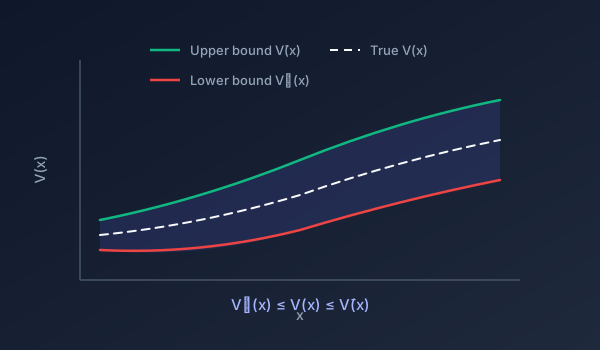
Recent advances have dramatically improved verification efficiency. Certified training frameworks now integrate verification directly into the learning process, optimizing neural networks specifically for verifiability [7]. Branch-and-bound techniques adaptively partition the input space, focusing computational effort on regions where verification is most difficult. GPU acceleration enables verification that once took days to complete in minutes.
Beyond Stability: Control Barrier Functions
While Lyapunov functions guarantee convergence to a goal, many applications require stronger guarantees about constraint satisfaction. Control Barrier Functions (CBFs) complement Lyapunov methods by certifying that systems remain within safe operating regions [8].
A barrier function defines a boundary between safe and unsafe states. If the system state ever approaches this boundary, the barrier function's derivative condition forces the controller to steer back toward safety. Neural network representations of barrier functions enable complex, non-convex safe regions that would be impossible to specify analytically [9].
The combination of Lyapunov and barrier functions provides comprehensive behavioral guarantees. Systems can be certified to reach desired goals while never entering forbidden regions. For autonomous vehicles, this might mean guaranteed collision avoidance while reaching a destination. For robotic manipulators, guaranteed task completion without exceeding joint limits or contact forces.
Implications for AI-Native Architecture
Controlled Evolution
Systems can add new capabilities only when mathematical analysis proves they preserve stability. Complexity grows along trajectories that maintain essential guarantees.
Runtime Certification
Before deploying updated policies, systems verify stability certificates. Changes that fail verification are rejected automatically, preventing degradation.
Compositional Safety
Individual components carry their own stability certificates. System-level guarantees emerge from compositional reasoning about certified components.
Provable stability transforms how AI-native systems evolve. Rather than hoping that changes improve behavior, systems can verify it mathematically. The infrastructure reasons formally about its own evolution, ensuring that optimization today does not become catastrophic failure tomorrow [10].
The Path Forward
Significant challenges remain. Current verification techniques work best for relatively small networks and low-dimensional systems. Scaling to the massive neural networks used in modern AI requires new theoretical and computational approaches. The gap between what can be verified and what practitioners want to deploy remains substantial.
Yet progress is accelerating. Each year brings more efficient verification algorithms, larger certified networks, and broader classes of systems with formal guarantees. As these techniques mature, provable stability will transition from research achievement to engineering requirement. AI systems that cannot demonstrate mathematical safety guarantees may become undeployable in critical applications.
The spinning top maintains equilibrium through continuous motion. AI-native systems maintain stability through continuous verification, ensuring that every adaptation, every optimization, every evolution preserves the mathematical properties that guarantee safe behavior.
References
- S. M. Richards et al., "The Lyapunov Neural Network: Adaptive Stability Certification for Safe Learning of Dynamical Systems," arXiv, 2018, [Online]
- H. Dai et al., "Lyapunov-stable neural-network control," arXiv, 2021, [Online]
- R. Zhou et al., "Neural Lyapunov Control of Unknown Nonlinear Systems with Stability Guarantees," arXiv, 2022, [Online]
- L. Yang et al., "Lyapunov-stable Neural Control for State and Output Feedback: A Novel Formulation," arXiv, 2024, [Online]
- F. Berkenkamp et al., "Safe Model-based Reinforcement Learning with Stability Guarantees," arXiv, 2017, [Online]
- N. Vertovec et al., "Scalable Verification of Neural Control Barrier Functions Using Linear Bound Propagation," arXiv, 2025, [Online]
- Z. Shi et al., "Certified Training with Branch-and-Bound: A Case Study on Lyapunov-stable Neural Control," arXiv, 2024, [Online]
- D. S. Kushwaha and Z. A. Biron, "A Review on Safe Reinforcement Learning Using Lyapunov and Barrier Functions," arXiv, 2025, [Online]
- H. Hu et al., "Verification of Neural Control Barrier Functions with Symbolic Derivative Bounds Propagation," arXiv, 2024, [Online]
- T. Su et al., "A Review of Safe Reinforcement Learning Methods for Modern Power Systems," Proceedings of the IEEE, 2025, [Online]
When Seeing Everything Becomes the Only Option
Why AI-Native architectures demand instrumentation of everything, from routing decisions to governance actions, and how emerging observability frameworks are making autonomous systems transparent and accountable
Intelligent Composability: Building AI Systems Like Orchestra, Not Soloists
How modular AI architectures achieve superior performance through specialized components, intelligent routing, and dynamic collaboration rather than monolithic intelligence
Discuss This with Our AI Experts
Have questions about implementing these insights? Schedule a consultation to explore how this applies to your business.