
Algorithms Used in Autonomous Fighter Jet Flight Research
Hierarchical Reinforcement Learning and Liquid Time-Constant Networks, in Light of DARPA's VENOM Program
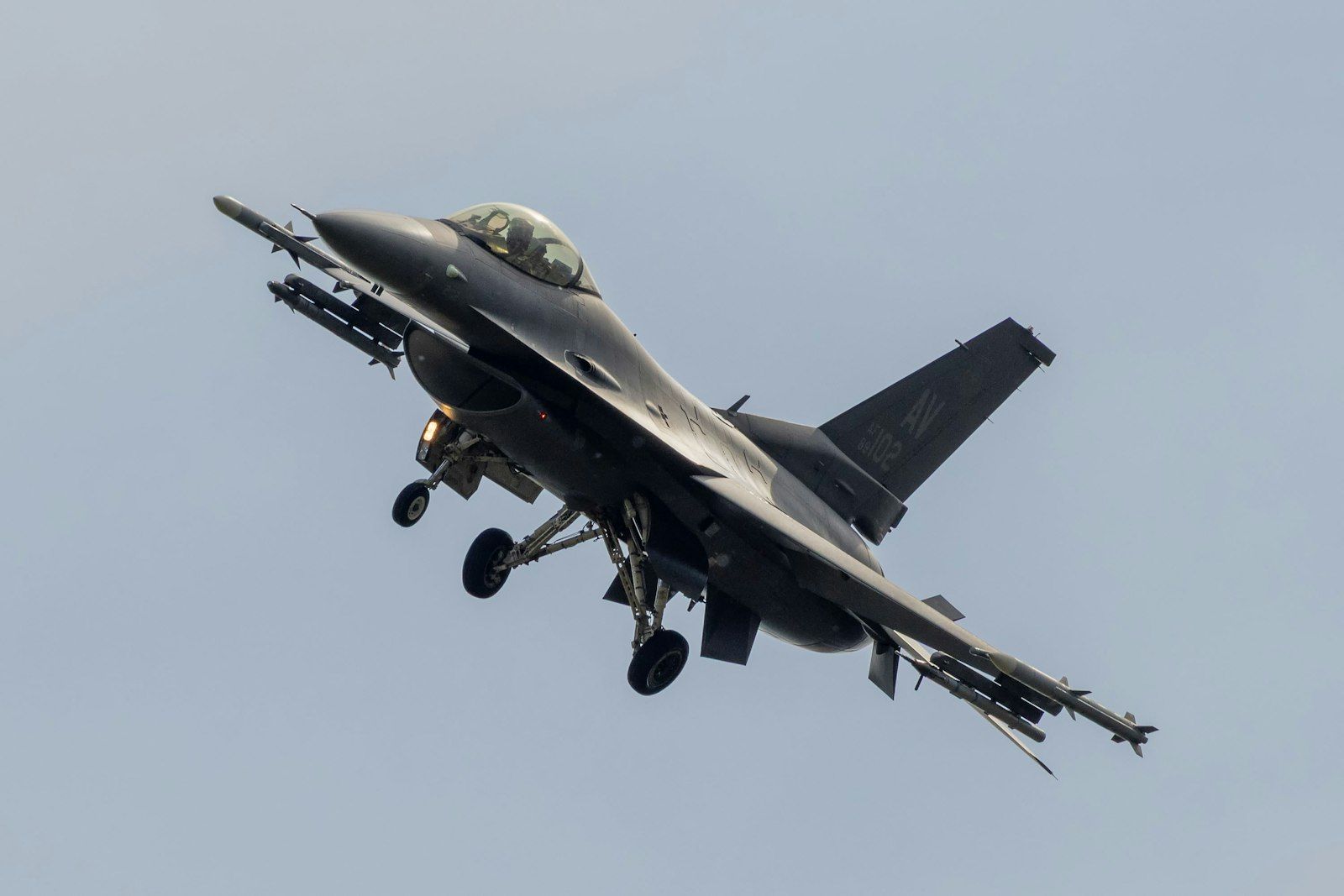
In July 2026, DARPA and the U.S. Air Force announced that a modified F-16 had flown under the control of an "AI agent," part of a program called the Viper Experimentation and Next-generation Operations Model, or VENOM [1]. The release describes a hardware and software kit bolted onto an otherwise unmodified F-16, letting a pilot flip a switch between human and AI control [1]. At least four F-16s have been outfitted with the kit so far, including an added auto-throttle that lets the AI agent regulate thrust alongside the control surfaces [7].
That headline is a good prompt to ask a broader question: what does the published research on teaching a model to fly a fighter jet, without a human in direct control, actually look like? VENOM sits downstream of a well documented lineage, DARPA's Air Combat Evolution program, and that lineage has produced two distinct, peer-reviewed approaches to that problem. Neither one is exotic by the standards of applied machine learning, and both are worth understanding in their own right.
The Dogfighting Brain Trust
The more heavily documented of the two threads traces back to DARPA's AlphaDogfight Trials, a 2020 competition designed to test whether an AI agent could hold its own in simulated within visual range air combat, more commonly called a dogfight. A Lockheed Martin team built an agent called PHANG-MAN that split the dogfight into three specialized sub-behaviors, a Control Zone policy for establishing a dominant position, and two variants of a shooter policy, one aggressive and one conservative about when to take a shot [2]. A higher level "policy selector" watched the engagement and switched between these three specialists roughly ten times per second, weighing the current distance and angle between the jets along with the closure rate, how quickly that gap was shrinking or growing [2].
This is a hierarchical reinforcement learning design, meaning the system learns by trial, error, and reward rather than by copying a human, and it leans on several small, specialized learners instead of one big one. The training algorithm underneath is worth naming correctly, since it is often described elsewhere as Proximal Policy Optimization. The paper itself specifies a related but different method called Soft Actor-Critic, which rewards the system for trying a variety of moves while it is still learning instead of locking onto one tactic too early [2]. That distinction matters more for accuracy than for the outcome, since both algorithms belong to the same toolkit that shows up across modern robotics control. What actually made PHANG-MAN notable was never really the base algorithm. It was the decomposition, training three narrow specialists and a switcher rather than asking one policy to handle every situation. In the tournament, PHANG-MAN finished second overall, and in a separate best of five match, it defeated a graduate of the U.S. Air Force's F-16 Weapons Instructor Course five wins to zero losses [2].
This same style of hierarchical policy work is the lineage that DARPA credits as feeding into live flights on the X-62A VISTA, a heavily modified F-16 used as the ACE program's flying testbed, which in 2024 completed the first in-air dogfight between an AI-piloted and human-piloted F-16 [6]. VENOM's stated purpose is to take those lessons and move them off a one of a kind research aircraft and onto standard operational airframes [1].
Liquid Time-Constant Networks: A Different Approach to Memory
A separate research thread trained an entirely different kind of model to fly the same job. A team from the Department of the Air Force-MIT AI Accelerator, working with MIT Lincoln Laboratory and the university's Computer Science and Artificial Intelligence Laboratory, trained a Liquid Time-Constant network to fly the X-62A VISTA, and reportedly reached autonomous live flight in roughly six months, faster than the multi-year timelines that ACE-style reinforcement learning training has typically required [3].
A Liquid Time-Constant network, or LTC, takes a different approach to memory than most neural networks. A standard recurrent network, the kind used inside an LSTM, checks in on its own internal memory at fixed, evenly spaced intervals no matter what is happening around it, more like a strobe light than a dimmer switch. An LTC instead lets a differential equation, essentially a rule for how its internal state should change from one moment to the next, adjust its own update speed depending on how quickly the incoming data itself is changing [4]. The architecture's creators also designed it to stay well behaved rather than spiral out of control as inputs keep shifting, a property standard recurrent networks are not guaranteed to have [4]. Rather than training this network with reinforcement learning, the DAF-MIT team used imitation learning, where a model learns to copy an expert's recorded behavior directly instead of discovering a strategy on its own through trial, error, and reward [3].
Why the Architecture, Not Just the Timeline, Is the Interesting Part
A chip only does what its circuit lets it do, and an LTC network's circuit is built to keep adjusting how fast it forgets. A separate, peer-reviewed study from the same MIT group tested this property directly, training LTC-based drones by imitation learning and then flying them through forests and neighborhoods they had never seen during training. Engineers have a name for that kind of mismatch between what a model saw in training and what it meets in the real world, a distribution shift [5]. Compared against six other recurrent architectures sharing the same visual front end, the liquid networks were the ones that kept working once the scenery changed out from under them, a result the researchers attribute to the architecture learning the causal structure of the task itself, tracking the target rather than memorizing incidental details of the training environment [5].
That robustness to unfamiliar surroundings is not a side note. It is exactly the kind of property that matters once any flight autonomy system leaves a clean simulation for real, changing sensor conditions, something the earlier ACE-era flights on VISTA were not required to demonstrate.
The Same Buildup, Regardless of Algorithm
Both approaches, and any successor to either one, share a development path, because every public account of this program family describes the same buildup. First comes software-in-the-loop simulation, running the AI purely against a simulated version of the jet. Then hardware-in-the-loop simulation, pairing that same software with real flight hardware sitting on the ground. Then constructive modeling, larger simulated exercises where computer generated aircraft stand in for real ones. Only then does live flight happen, and the whole process can run from months to years [3].
Much of this pipeline runs on JSBSim, an open source, C++ flight dynamics model that both the PHANG-MAN and VENOM-adjacent research use to simulate an F-16's six degrees of freedom, essentially every way the jet can move and rotate through the air, before anything touches real hardware [2]. A newer, lighter weight tool called Tunnel, built specifically anticipating VENOM and its follow-on program's needs, wraps this kind of flight dynamics model in Gymnasium, a standard software interface used widely across reinforcement learning research, so researchers can swap in new sensors, tasks, and training methods in days rather than months [3]. The comparison study behind Tunnel is a useful data point on its own, in a basic navigation task, an agent trained by imitation learning off a simple autopilot reliably reached its goal, while reinforcement learning agents given the same sensor data only got there some of the time [3]. That paper also flags something closer to a design constraint than a finding, direct control of the flight surfaces by a reinforcement learning agent is generally considered unreliable, which is a likely reason ACE-era systems hand the model a higher level command, stick, rudder, and throttle position, rather than letting it move individual control surfaces on its own [3].
Why This Keeps Getting Harder
Naming these two approaches is not the same as explaining why teaching a jet to fly itself keeps getting harder as the work moves closer to a real cockpit. VISTA's ACE-era flights gave the AI agent the opponent's exact position, velocity, and orientation, pulled directly from the simulation's internal state, with no modeled sensor noise at all [2]. The published research describing this program lineage frames later stages of the work as needing to run off actual operational sensors instead, a modern scanning radar, a receiver that warns the pilot when another aircraft's radar is pointed at the jet, a broader electronic warfare system, and likely an infrared camera for spotting other aircraft without radar at all [3]. Real sensors bring real problems that a simulation's clean, ground truth data never has to answer for. A warning receiver can throw false alarms. A radar can be genuinely unsure exactly how far away or how fast something is moving. Any stretch of flight where GPS is jammed or unavailable leaves a jet's own navigation system slowly drifting off course [3].
The same literature describes the follow-on AIR program's research goal in those terms directly, building autonomy that holds up under "partial observability, concept drift, and uncertainty" across scenarios involving multiple aircraft at once [3]. That is a more general statement of the same problem that hierarchical reinforcement learning and imitation learning were both built, in their own ways, to handle inside a simulator.
"The Air Force and DARPA team has automated flight controls and sensors on a standard F-16 without changing the jet's core software. This enables an efficient pipeline for developing dominant AI for aerial combat, allowing us to rapidly innovate for the warfighter."
— Brig. Gen. James Valpiani, DARPA
The Bottom Line
Flight autonomy, as a field, already has two separately vetted, peer-reviewed answers to the core problem of teaching a jet to fly itself: a hierarchical reinforcement learning system that beat a human weapons instructor in simulation, and an imitation-learned continuous-time network that reached live flight faster than expected and later demonstrated a specific talent for holding up under unfamiliar conditions. Both took different paths to the same goal, and both passed through the same buildup of software simulation, hardware testing, and constructive exercises before either one ever touched a runway. That is the published toolkit behind this corner of applied machine learning, developed and tested for years before a headline like VENOM's put it back in the news.
References
- "DARPA, U.S. Air Force fly AI-controlled F-16," DARPA, 2026, [Online]
- A. P. Pope et al., "Hierarchical Reinforcement Learning for Air Combat at DARPA's AlphaDogfight Trials," IEEE Transactions on Artificial Intelligence, vol. 4, no. 6, pp. 1371-1385, 2023. DOI: [Online]
- G. F. Search, "Training Environment for High Performance Aircraft Reinforcement Learning," arXiv, 2025, [Online]
- R. Hasani et al., "Liquid Time-constant Networks," Proceedings of the AAAI Conference on Artificial Intelligence, vol. 35, no. 9, pp. 7657-7666, 2021. DOI: [Online]
- M. Chahine et al., "Robust flight navigation out of distribution with liquid neural networks," Science Robotics, vol. 8, no. 77, 2023. DOI: [Online]
- "ACE Program Achieves World First for AI in Aerospace," DARPA, 2024, [Online]
- "DARPA and US Air Force fly frontline F-16 modified for autonomous flight," FlightGlobal, 2026, [Online]
Orchestration Without a Signal From the Room
Agent stacks can look like architecture, specialists, tools, memory, a planner, and still send no training signal back to the module that is conducting the work. The room already answered. The graph often does not listen.
Delegating the Job Is Not the Same as Delegating the Rules
When an AI agent hands a task to another AI agent, the work travels cleanly down the chain, but the boundary around that work often does not. A new benchmark and two companion studies keep finding the same thing, permission gets lost almost entirely at the very first handoff, and the systems that finish the most work are consistently the ones that lose track of it fastest.
Discuss This with Our AI Experts
Have questions about implementing these insights? Schedule a consultation to explore how this applies to your business.