
Designing for Graceful Failure in Compound AI Systems
When One Agent Falls, the System Must Still Stand

Compound AI systems, architectures in which multiple specialized AI agents collaborate to complete complex tasks, are becoming the dominant model for production AI-Native deployment. One agent retrieves information, another reasons over it, a third formats and delivers results. When it works, the result is impressive. When it fails, the consequences are rarely as simple as a single error message.
The core challenge is that failure in a compound AI system does not look like a crash. An agent that hallucinates (producing confident but factually wrong output) does not throw an error. An agent that times out mid-task may leave downstream agents waiting on data that will never arrive. A reasoning component that returns subtly nonsensical output can corrupt every subsequent step in the pipeline, and the system may report success the entire time. Research now confirms what engineers who have built these systems already suspect, that failures in multi-agent systems are "frequently complex," involving compounding effects across agent interactions rather than clearly isolated faults [1].
Why Compound Systems Break Differently
Before designing for resilience, it helps to understand why multi-agent failure is a distinct problem from single-model failure. In a traditional application, an error in one component typically produces a detectable signal, a crash, an exception, or a null return value. Multi-agent systems break this assumption.
Research analyzing seven popular multi-agent systems identified 14 distinct failure modes, organized into three broad categories that span specification and system design failures, inter-agent misalignment, and task verification and termination failures [1]. What makes this taxonomy significant is not the number of failure modes but the implication that most of them are invisible by default. An agent may complete its assigned task according to its own internal logic while producing output that is semantically wrong for the context it operates in.
The scaling dynamics make this worse. Research into multi-agent scaling has formalized the intuition that "more moving parts increase fragility," finding quantitatively that each additional tool in an agent's chain amplifies error sensitivity [2]. A system with five specialized agents is not five times more fragile than a single agent. The error amplification is multiplicative across coordination paths. Centralized architectures, where a coordinator validates outputs before passing them along, showed substantially higher resilience than flat peer-to-peer designs, despite the added overhead [2].

The Silent Failure Problem
Agent failures wear a mask of plausibility. Unlike a software crash, they present as normal-looking outputs. A hallucinating agent does not know it is wrong. A timed-out agent may return a cached or partial result indistinguishable from a valid one. Without active detection mechanisms to look behind that mask, these failures propagate downstream until they surface as user-facing errors, often far removed from their origin.
Fallback Chains and Degradation Hierarchies
The engineering response to this challenge starts with accepting that every AI component in a production system will eventually fail, and designing accordingly. This means building explicit degradation hierarchies, predetermined sequences of fallback behaviors that trigger when a primary agent cannot perform reliably.
A well-designed degradation hierarchy for a question-answering agent might proceed through three levels, starting with full AI reasoning with retrieval, falling back to a simpler retrieval-only response that surfaces raw source documents without synthesis, and finally handing off to a human operator with relevant context attached. The key insight is that each level must be independently functional, not merely a warning that the primary system failed. Research on cognitive degradation in agentic systems identifies "fallback logic rerouting," the ability to redirect execution to predefined safe outputs when primary logic degrades, as one of seven essential runtime controls for production AI [3].
The analogy from distributed systems engineering is the circuit breaker pattern. A circuit breaker, in software terms, monitors a downstream component for repeated failures and, after a defined threshold, stops sending requests to it entirely, routing traffic to a fallback instead. Applied to AI agents, this means tracking output quality signals in real time, and automatically reducing the system's reliance on a component whose behavior has degraded below an acceptable threshold, before users notice the problem.
Detecting Failure Before It Reaches Users
Circuit breakers require signals to trip them. This is where hallucination detection becomes a structural concern rather than a model improvement concern. Research on watchdog frameworks for LLM-based agents demonstrates that hallucination monitoring can be implemented as a layer external to the model itself, requiring no access to the model's internal state [4]. This matters enormously for compound systems built on commercial APIs, where internal model inspection is impossible.
Reliability as a Multi-Dimensional Property
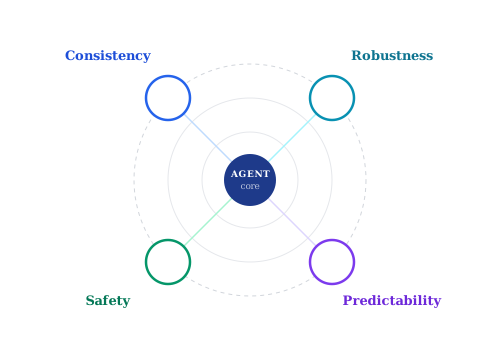
Agent reliability cannot be inferred from average task success alone. Research proposes measuring it across four independent dimensions of consistency, robustness, predictability, and safety. A system that scores well on one dimension can fail badly on another, and those failures often only appear in production. [5]
Practically, effective pre-user detection combines three instrumentation layers. First, output confidence monitoring, which tracks consistency signals across repeated or varied queries to identify agents operating outside their reliable range. Second, latency-based health probes, continuous checks that flag agents showing response time anomalies, a common early signal of context flooding or resource exhaustion [3]. Third, cross-agent consistency checks at coordination boundaries, where a lightweight validator confirms that an agent's output is plausibly coherent with the inputs it received before passing results downstream.
The Topology Question
Architecture is not neutral with respect to resilience. Research on optimizing multi-agent system structure found that both the topology (how agents connect to each other) and the prompts governing their behavior have strong, measurable impacts on overall resilience [6]. Hierarchical structures, where a coordinator validates and routes between specialized agents, consistently outperform flat collaborative structures when faulty agents are present [7]. The coordinator's advantage is not merely that it can catch errors, but that centralized validation creates a natural checkpoint where fallback logic can activate before errors propagate.
This finding has a practical implication that goes beyond architecture diagrams. Teams building compound AI systems should treat the coordinator agent as the primary resilience surface, the component most heavily instrumented, most aggressively tested, and most conservatively designed. Complexity and creativity belong in specialized sub-agents, while the coordinator's job is to be reliably boring.
What This Means for Production Teams
The gap between AI systems that impress in demos and AI systems that hold up in production is largely a gap in failure design. Graceful degradation requires upfront decisions about what "acceptable failure" looks like at each layer, instrumentation that surfaces failure signals before they become user-visible, and fallback paths that are tested as rigorously as primary paths.
The research is clear that these properties do not emerge automatically from capable models or clever prompting. They require explicit architectural choices made early, before the system is under load and before the pressure to ship has narrowed the design space. Building for graceful failure is not pessimism, it is the engineering discipline that separates systems that scale from systems that eventually collapse under their own complexity.
References
- M. Cemri et al., "Why Do Multi-Agent LLM Systems Fail?," arXiv, 2025, [Online]
- Y. Kim et al., "Towards a Science of Scaling Agent Systems," arXiv, 2025, [Online]
- H. Atta et al., "QSAF: A Novel Mitigation Framework for Cognitive Degradation in Agentic AI," arXiv, 2025, [Online]
- S. Liu et al., "Towards Mitigation of Hallucination for LLM-empowered Agents: Progressive Generalization Bound Exploration and Watchdog Monitor," arXiv, 2025, [Online]
- S. Rabanser et al., "Towards a Science of AI Agent Reliability," arXiv, 2026, [Online]
- Z. Zhou et al., "ResMAS: Resilience Optimization in LLM-based Multi-agent Systems," arXiv, 2026, [Online]
- J. Huang et al., "On the Resilience of LLM-Based Multi-Agent Collaboration with Faulty Agents," arXiv, 2024, [Online]
Reward Design as Architecture
The reward function is the most consequential design decision in any reinforcement learning system, yet it receives almost no architectural treatment. This article examines reward shaping pitfalls, sparse versus dense trade-offs, reward hacking, and how reward specification integrates with the broader AI-native objective hierarchy.
The Data Infrastructure AI-Native Systems Can't Ignore
AI-Native architectures depend on their data infrastructure, yet architectural discussions often focus on compute and orchestration. Feature stores, embedding pipelines, vector databases, data versioning, and the real-time versus batch tension shape every production AI system.
Discuss This with Our AI Experts
Have questions about implementing these insights? Schedule a consultation to explore how this applies to your business.