

Every software engineer learns early that a test is only as good as its oracle, the mechanism that determines whether a result is correct. For decades that oracle was simple, returning an expected value or not. AI-Native systems, built from probabilistic language models and adaptive agents, break this assumption at its foundation. The same input can produce meaningfully different outputs on successive runs. Failure may not announce itself with a crash. Instead it accumulates as a slow drift in quality, a routing decision that is subtly worse today than it was last week, a response that is plausible but wrong in ways that only surface later. Testing what cannot be fully predicted requires rethinking evaluation from the ground up.
Why Traditional Testing Fails
The non-determinism of AI components is not a bug to be fixed but a fundamental property of how they work. As the migration from monolith to AI-Native makes clear, the gradual, silent nature of degradation in these systems means that traditional test frameworks, built around deterministic outputs and atomic oracles that treat each execution as an isolated event with a single correct answer, are structurally mismatched to the problem [1]. When the system under test is a compound AI architecture where multiple agents pass probabilistic outputs to one another, the mismatch deepens. Behavioral deviations that matter in production, such as an agent skipping a required validation step or misinterpreting a policy constraint, surface only at runtime rather than in any static validation phase [2].
The implications are practical and immediate. A test suite that passes every run cannot guarantee that the system will behave consistently across the full distribution of inputs it will encounter in production. When a model update silently changes the underlying distribution of outputs, existing tests may continue to pass while the observable behavior of the system has shifted in ways that matter to users [3].
Behavioral Contracts Between AI Modules
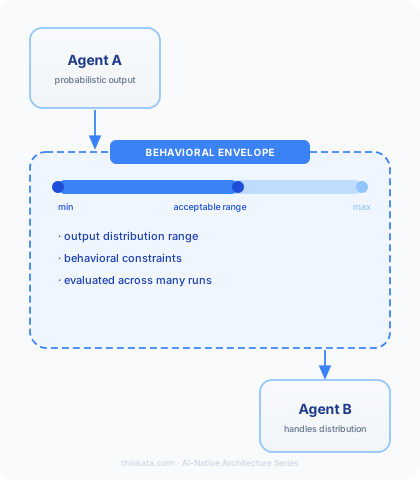
From Interface Contracts to Behavioral Envelopes
In traditional microservice architectures, contract testing verifies that one service's output matches the format that the next service expects. In AI-Native systems, the format may be correct while the content is unreliable. A behavioral contract must therefore specify not just the shape of an output but the envelope of behaviors that downstream components can safely handle. Evaluating LLM agents across four dimensions, reasoning, memory, tool use, and environmental interaction, provides a structured way to define where each component's responsibilities begin and end [2].
A comprehensive evaluation taxonomy for LLM agents reinforces this framing by organizing testing along two axes. The first covers what to evaluate: agent behavior, capability, reliability, and safety. The second covers how to evaluate: interaction modes, metric computation, and tooling [4]. This structure maps directly onto the challenge of contract testing in compound AI. Each module in a pipeline can be tested against its behavioral obligations independently, verifying that it handles the range of inputs it will realistically receive and produces outputs within the range that downstream modules can process. The failure mode that traditional contracts miss, a module whose output is technically well-formed but subtly wrong, becomes visible only when evaluation measures behavioral consistency across many samples rather than correctness against a single expected answer.
Evaluation Harnesses and Continuous Testing
If behavioral contracts define what each module owes its neighbors, evaluation harnesses define how those obligations are verified over time. The concept of evaluation-driven development, adapted from Test-Driven Development for AI systems, treats evaluation evidence as the primary feedback mechanism throughout an agent's lifecycle, not just a gate before deployment [5]. In practice this means running both offline evaluations against controlled scenarios and online evaluations that capture real-world behavioral patterns under operational variability. Unlike traditional TDD, which assumes stable specifications and deterministic outcomes, this approach accommodates the reality that AI agents pursue under-specified goals and continue to adapt after deployment.
Offline Evaluation
Controlled regression suites run against captured trajectories, scoring outputs on behavioral criteria rather than binary correctness. Useful for detecting degradation after a model update before it reaches production.
Online Evaluation
Real-time behavioral monitoring tracks quality signals in production, using aggregated metrics across many interactions to detect drift that no single test case would surface on its own.
AI-as-Judge
A growing approach uses AI agents as the evaluators themselves, assessing not just whether an agent reached a correct final answer but how it reasoned and acted along the way [6].
The AI-as-judge approach addresses the scale problem that makes human review impractical in production. Rather than checking only a final answer, a judge agent can examine the full chain of reasoning and intermediate actions taken by a task agent, providing rich feedback that simple pass/fail metrics cannot capture. Ensemble judging, where multiple AI evaluators score independently and their results are aggregated, reduces individual judge biases and produces more reliable quality signals [6].
Regression Detection When Models Update
Even with robust contracts and continuous harnesses in place, a separate class of problem remains. Models served via an API may be silently updated by the provider, changing the distribution of outputs without any change to the calling code. Detecting these shifts is one of the most practically consequential challenges in AI-Native testing. Research shows that simple statistical tests applied to linguistic features of model outputs, comparing distributions before and after a suspected change, can detect model modifications reliably and at far lower cost than running full benchmark evaluations [3].
Task Drift as a Signal
Beyond detecting model changes, evaluation harnesses must watch for task drift within a running system. Task drift occurs when a component's internal activation patterns shift in response to external data, a signal that the agent has been influenced away from its original instruction by content it encountered during execution [7]. Activation-level monitoring, which tracks the internal state of the model rather than just its outputs, offers a way to detect this drift before it becomes visible in degraded outputs. This represents an important frontier for instrumentation in AI-Native observability.

The tooling landscape for AI-Native evaluation is maturing rapidly. Open-source frameworks such as DeepEval, Promptfoo, and Giskard have emerged to support layered testing across the system shell, orchestration logic, and model inference core. Yet analysis of six leading frameworks shows that most still treat each test execution as isolated, lacking explicit mechanisms for handling the stochastic variability that is intrinsic to production AI systems [1]. Filling this gap requires aggregated oracles, evaluation methods that accumulate evidence across many runs rather than rendering verdicts on individual responses.
What This Means
The shift to AI-Native systems demands a corresponding shift in how quality is defined and measured. Behavioral contracts replace interface contracts. Continuous evaluation harnesses replace one-time test suites. Statistical change detection replaces binary pass/fail regression. And AI agents, equipped with reasoning capabilities, increasingly evaluate other AI agents at a scale and depth that human review cannot match. The tooling is still catching up to the theory, but the conceptual foundations are clear. Evaluation must be probabilistic, continuous, and lifecycle-wide. For engineering teams building these systems, investing in evaluation infrastructure early, before the system reaches production, is not optional overhead. It is the mechanism by which the system remains trustworthy as it grows.
References
- F. Dobslaw et al., "Challenges in Testing Large Language Model Based Software: A Faceted Taxonomy," arXiv, 2025, [Online]
- S. Akshathala et al., "Beyond Task Completion: An Assessment Framework for Evaluating Agentic AI Systems," arXiv, 2025, [Online]
- A. Dima et al., "You've Changed: Detecting Modification of Black-Box Large Language Models," arXiv, 2025, [Online]
- M. Mohammadi et al., "Evaluation and Benchmarking of LLM Agents: A Survey," arXiv, 2025, [Online]
- B. Xia et al., "Evaluation-Driven Development and Operations of LLM Agents: A Process Model and Reference Architecture," arXiv, 2024, [Online]
- F. Yu, "When AIs Judge AIs: The Rise of Agent-as-a-Judge Evaluation for LLMs," arXiv, 2025, [Online]
- S. Abdelnabi et al., "Get my drift? Catching LLM Task Drift with Activation Deltas," arXiv, 2024, [Online]
The Data Infrastructure AI-Native Systems Can't Ignore
AI-Native architectures depend on their data infrastructure, yet architectural discussions often focus on compute and orchestration. Feature stores, embedding pipelines, vector databases, data versioning, and the real-time versus batch tension shape every production AI system.
Building the Plane While Flying It — Migrating from Monolith to AI-Native Without Stopping
Sequencing the transition, hybrid stages, risk management, and organizational readiness factors that determine whether a migration from traditional to AI-Native architecture succeeds
Discuss This with Our AI Experts
Have questions about implementing these insights? Schedule a consultation to explore how this applies to your business.